
About
I arrived at law school not knowing how to study for it.
Nobody teaches you. You're handed a syllabus and a reading list that assumes you already know what to do with them. Most of us work out the method somewhere around our first set of exams — which is exactly one semester too late.
I went looking for something that would tell me how the work actually fits together. What goes in a case brief. How an outline gets built, and why it matters more than anything else you produce. What a hypo answer is supposed to look like before you've ever written one.
What I found were planners. Pretty grids, undated boxes, made by people who have never been cold-called.
So after I graduated, I built the thing I needed in first year.
Dictum is a method, not stationery.
It runs on one loop.
Read a week ahead, so class is your second pass through the material rather than your first. Brief the cases down to the rule that transfers. Outline the topic in your own words, the week you learn it.
Read · Brief · Outline. That's the whole system, and everything here is built to keep you inside it.
The outline is the exam.
Not your notes. Not your briefs. Not the four hundred pages you highlighted in October.
The outline is the only document you carry into the room, which makes writing it the actual studying — everything else is raw material feeding into it. Which is why it can't be a November project. A topic outlined the week you learned it takes about an hour. The same topic outlined in November takes three to five, and you'll have forgotten why the case mattered.
Every page in every Dictum product points at that outline.
Why it's built after the fact, not during
I could have written this in first year. It would have been worse.
A student knows what they knew at the time. Three years later you know which habits paid off, which ones were wasted effort, and what you'd tell yourself on day one if you could. Dictum is built with that hindsight — which is the one thing a first-year can't get anywhere else, and the reason this isn't a planner with a law-themed cover.
Who this is really for
I'm a law graduate and I practice in Ontario. I did well enough. I was not a straight-A student, and that turns out to be the point.
Law school is hard. But when it goes badly, it's rarely because someone isn't smart enough. It's because nobody handed them the structure — and some people arrive already holding it.
If you have lawyers in your family, or you figured law was your goal early on and did pre-law, you absorbed a lot before you ever opened a casebook. You knew roughly what an outline was. You had someone to ask what a professor meant by "the ratio." If you didn't — if nobody around you practises, or they practise somewhere the rules work differently — you're learning the law and learning how to learn the law at the same time, and only one of those is on the syllabus.
That gap is what Dictum is for.
There's more out there now than there was. Law students and lawyers share genuinely useful things on TikTok and other Social Media, and a good thread can save you a week. But scattered advice isn't a method. Knowing that outlines matter is not the same as knowing what goes in one, when to write it, or how it turns into an exam answer. The formula is learnable — it's just that most people are left to reverse-engineer it alone, usually after their first set of marks.
You don't have to. That's the whole idea.
What's here
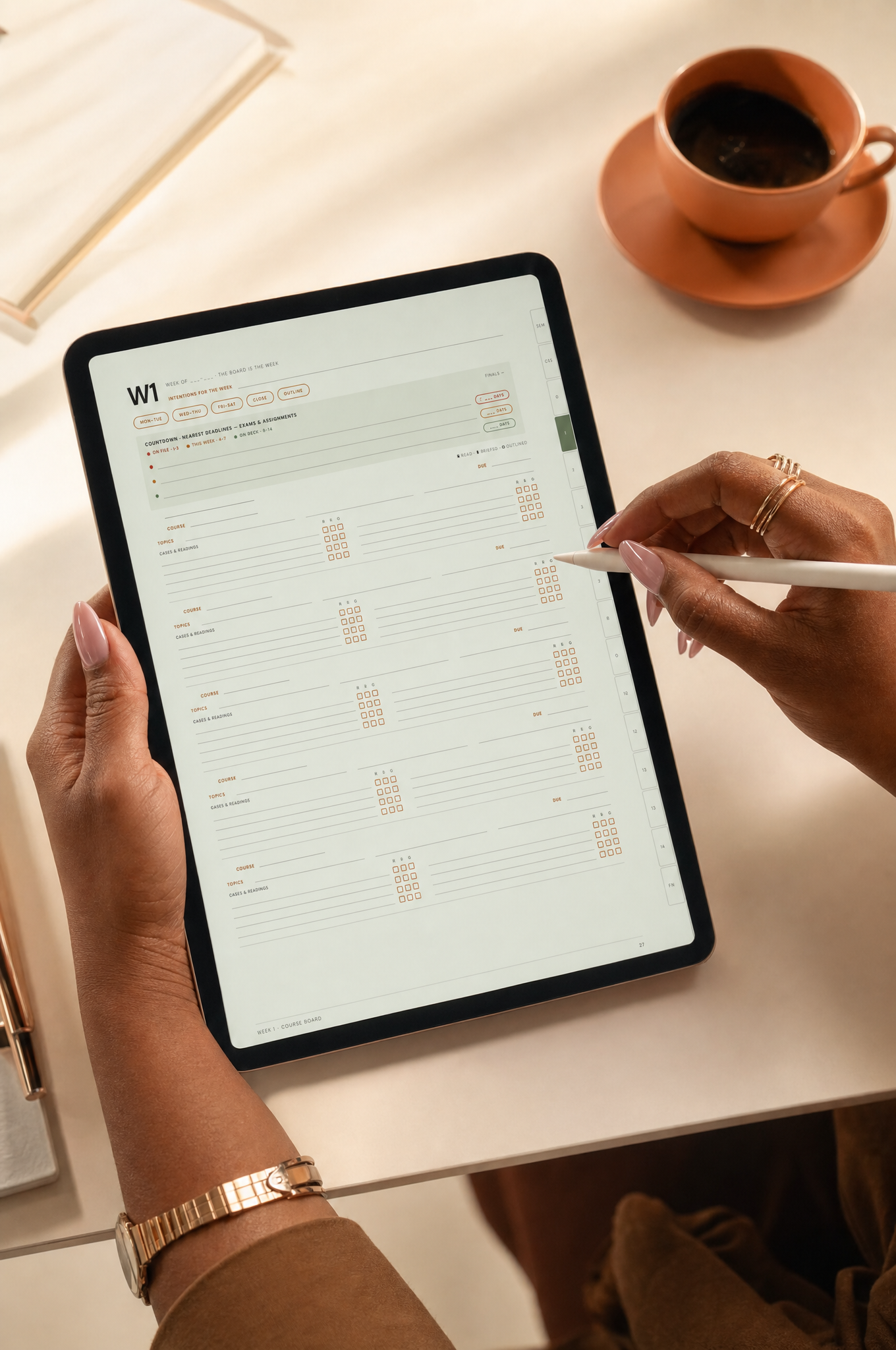
The Semester Planner runs your term. Course boards, day pages, weekend outline reviews, finals boards. Undated, so it works for any semester in any year.
The Worksheet Library shows you what the work looks like when it's done. Fourteen sheets covering reading a case, briefing it, answering a hypo, writing a legal memo, an exam essay, and a research paper.
The Complete Method is both.
Everything ships in full colour for tablets and a low-ink edition for home printers, in A4 and US Letter.
Who it's for
Common-law students — Canada, the US, the UK and Australia. The worked examples use Canadian authorities, but the method transfers; swap in your own cases.
Built for first year, because that's when nobody tells you how any of this works. But nothing about it expires — the loop is the same in second and third year, and the worksheet library covers memos, essays and research papers that turn up long after 1L.
Made in Canada
Dictum is one person. If you email, I'm the one who answers.
This is only the beginning with Dictum— more will come, including advocacy tools and potentially something more tech-focused. Stay tuned!